The site navigation utilizes arrow, enter, escape, and space bar key commands. Left and right arrows move across top level links and expand / close menus in sub levels. Up and Down arrows will open main level menus and toggle through sub tier links. Enter and space open menus and escape closes them as well. Tab will move on to the next part of the site rather than go through menu items.
Predicting Childhood Lead Exposure at the Census Tract Level
Challenge
Although lead exposure among U.S. children is declining, significant exposure and subsequent effects remain and harm children disproportionately in certain communities. The National Health and Nutrition Examination Survey (NHANES) estimates childhood lead exposure at a national level, but the data is insufficient for local programmatic decision-making. Identifying disproportionately affected communities remains difficult. State or local blood-lead surveillance data is not universally available; for example, seventeen states do not maintain blood-lead level (BLL) surveillance systems necessary to provide data to the Centers for Disease Control and Prevention. Thus, many U.S. communities have no BLL monitoring results, hindering efforts to reduce lead’s impact.
Solution
To help identify demographic predictors, we reviewed the literature to identify modeling results which relate childhood lead exposure, as measured by BLL, to predictive factors available at different spatial scales. The demographic predictor data was obtained from the U.S. Census Bureau based on information collected in the American Community Survey. For modeling purposes, we obtained surveillance data from the State of Michigan, Commonwealth of Massachusetts and State of Texas, collected as part of their public health programs. We merged the blood-lead data by census tract with the demographic predictor data. In addition to the predictors available at the census tract level, we also included the season of the blood-lead sampling, whether a capillary or venous blood sample was drawn, the age of the child and the year of the sample to account for long-term trends.
Impact
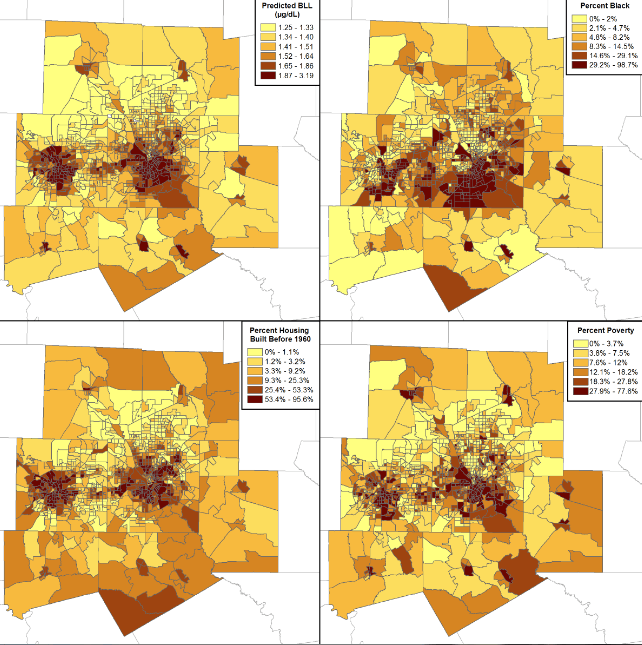
Combining the fitted regression model with readily available U.S. Census demographic predictor data provides predicted child BLL distributions at the census tract level for children of different ages or for populations at different points in time. These predictions provide a powerful quantitative tool for public health and housing officials and other stakeholders in childhood lead poisoning prevention. In particular, these distributions can be used to assess the number of children at risk in different parts of the urban area, which then can be used to help assess various intervention and resource allocation options. For example, the maps in the figure below provide predicted geometric mean BLLs at the census tract level for the Dallas/Ft. Worth area in Texas, along with census tract-level information on race (percentage Black), older housing (percentage built before 1960), and income level (percentage below the poverty level). By considering the demographic maps along with the BLL map, potential correlations can be considered at a useful level of geographic specificity when planning public health interventions or other types of actions.
Cross-disciplinary scientific and engineering collaboration is essential for innovation. Our experts, called “Solvers” at Battelle, combine multiple advanced materials expertise like these with other applied sciences and engineering disciplines to deliver comprehensive client solutions.
Materials Chemistry
Our comprehensive solutions require cross-disciplinary scientific and engineering collaboration. Battelle Solvers combine biology disciplines like these with other applied sciences and engineering to deliver client success.
Bioaerosol Science
Biomedical Engineering
Biostatistics
Genomics
Virology
Innovation requires multidisciplinary scientific and engineering collaboration. Our Solvers at Battelle combine multiple chemistry disciplines like these with other applied sciences and engineering expertise to deliver comprehensive client solutions.
Data science expertise is at the core of our multidisciplinary approach. Our experts, called “Solvers” at Battelle, combine data science disciplines like these with applied engineering and science to deliver comprehensive client solutions in government and industry.
Artificial Intelligence
Biostatistics
Data Analytics
Data Translation
Modeling and Simulation
Real-world solutions require multidisciplinary scientific and engineering collaboration. Our experts, called “Solvers” at Battelle, combine multiple engineering disciplines like these with other applied sciences to deliver comprehensive client solutions.
Biomedical Engineering
Chemical Engineering
Electrical Engineering
Genetic Engineering
Human Factors Engineering
Mechanical Engineering
Medical Device Engineering
Modeling and Simulation
Systems Engineering
Andre LaFreniere
Vice President, Commercial Business Development and Sales, Battelle Health
At Battelle, solving tough challenges is what we do. Let us know how we can help you. Let’s connect.
We use cookies to personalize content and ads, to provide social media features and to analyze our traffic. We also share information about your use of our site with our social media, advertising and analytics partners. By continuing to browse our
site without changing your settings, you are agreeing to accept all cookies on the site.